Baking Bread with Children

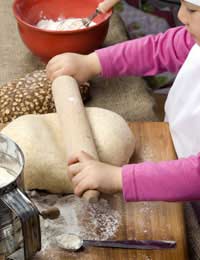
Turn your children into bakers for the day. This Cookery Group plan introduces your young chefs to the science of baking bread. There is plenty to learn and lots of intrigue as the bread rises with help from some magical yeast.
Running the Session
Because of the time it takes for bread to rise this session might be best for a weekend when you can plan different activities in between baking. It’s a great option for children who are asking for a cooking party – there’s plenty of time for some pass-the-parcel, and at the end, they can eat their own rolls with fresh fillings provided by the host.Equipment
For each child, you will need a roomy plastic bowl, a measuring spoon, a wooden spoon, a tea towel, and a wooden board. You will also need enough jugs to share between two or three, and a set of weighing scales.Preparation
In advance of the session , the host will need to warm the flour in a very low oven. You will need 4oz of flour per child. An hour before the group meeting, switch on your oven to its lowest temperature and weigh out 2oz of white bread flour and 2oz of soft grain or brown bread flour for every child who will be baking. Tip the flour into a large baking dish and leave in the oven to warm through. It should only just be warm and not hot, so check it 20 minutes before your group arrives.Explaining the Science
There is lots of science at work behind the scenes when you bake bread! Here are some points to include in your group meeting:- Yeast. This essential ingredient is actually a live organism and it is found ‘wild’ in fruit, on people, and even in the air of a baker’s kitchen. Just like any other living organism, yeast needs food to survive. It feeds on sugar, which it finds in the flour and in the sugar that you add to the mixture. As it’s ‘eating’, it expels alcohol (which is why it’s used in greater quantities to make wine) and carbon dioxide. This gas is what makes bread rise, puffing up as it bakes. At a high oven temperature, the yeast is finally killed off – which is why baked bread doesn’t continue to rise!
- Warmth. Keeping your bread mixture warm is important, because it gives the yeast the best chance to grow and produce carbon dioxide. If you wanted to slow down the rising process, you’d put your dough in the fridge. Yeast can survive in the fridge, but it will process sugars more slowly.
- Salt inhibits the growth of yeast, too. We add a little to the mixture to make sure that the yeast grows at a reasonable rate, and to improve the taste of the finished bread.
- Gluten. When flour is mixed with water, gluten is formed. Kneading gives the gluten the chance to stick together, creating long ‘strands’ which make the dough feel elastic. Natural starch reinforces the gluten, and when the loaf is baked, the gluten is ‘set’, holding in the bubbles.
Let's Get Started!
Step One: Into each child’s bowl, pour 2floz of warm water. Each child can now add ½ tsp of caster sugar and ½ tsp dried yeast. Stir together, then cover with a tea-towel and set the bowl aside until the yeast has ‘bloomed’, or fluffed up to give a foamy surface.Step Two: Weigh out 4oz flour for each child, or ask them to weigh it individually. When the yeast is ready, they can add the flour, as well as ½ tsp of olive oil and 1/2 tsp salt.
Step Three: Now the mixing begins! Using a wooden spoon, each child can mix up their dough, bringing the flour and yeast mixture together. At this point, walk around and check the consistency: if it's too dry add a splash more water, if too wet sprinkle in some extra flour. When it’s started to leave the sides of the bowl, then it’s time to knead by hand. Plonk the dough onto a floured wooden board and ask each child to knead for at least 5 minutes. Show your group how to knead, using the heel of your palm to push the dough against the board and away from you, before turning the dough for the next punch.
Step Four: When the dough has become soft and elastic, it’s time to shape it into rolls. Ask each child to be imaginative with their rolls, adding their initials or making a word. Finally, place each child’s rolls onto baking trays, cover with tea-towels, and leave in a warm place to rise. (Using a switched-off oven, into which you’ve put a tray of boiling water, is a good idea.) They’ll need at least an hour to double in size.
Step Five: At last, you can bake your bread. If you like, you could brush with egg or milk and sprinkle with poppy seeds or grated cheese. Bake at 180 degrees C for around 25 minutes, then cool before serving.